
Advantages
Bioidentidad® BioCard30 is the ultimate multifunctional device that combines fingerprint recognition with the reading of documents, passports, smart cards, and barcodes in a single unit.
It is a specialized identity device that meets the most modern and demanding identification needs.
It combines a high-precision fingerprint scanner (FBI FAP 30 certified) with multi-technology contact and contactless smart card readers/writers, a barcode reader, and a machine-readable zone (MRZ ICAO 9303) character reader.
- FBI PIV
FAP 30 - 25.40 mm
20.32 mm - Live
Detection - ISO 19794
ANSI 378 - Smartcard
ISO 7816 - NFC
ISO 14443 - Barcode
OCR MRZ
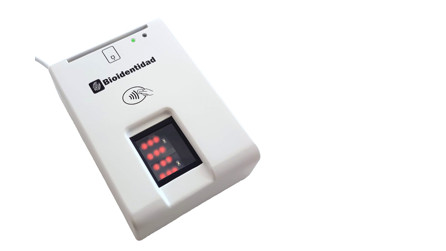
Modern identity validation
BioIdentity BioCard30 is designed to meet current and future identity needs, with the technological capacity to keep pace with emerging trends.
It is ideal for reading and authenticating national identity cards, passports and a variety of credentials, whether printed, electronic or digital, including app barcodes on smartphone screens.
It also enables highly secure biometric identity validation processes.
Bioidentidad® multi-technology
In addition to validating identity through fingerprints, it can interact with identity documents, passports, visas, smartphones, tags, and more, including contact smartcards, contactless smartcards (RFID 13.56 MHz, NFC, ICAO 9303, etc.), barcodes (QR, PDF417, etc.), and machine-readable zones (MRZ, ICAO 9303), in accordance with international and national technical standards, providing maximum functionality and security for the most modern and innovative applications.
Identity card reading
It is ideal for use with identity documents and identity cards, whether physical or digital (digital ID, electronic ID, eID), that have any type of reading technology, including contact chip, contactless chip, machine-readable zone (MRZ), card access number (CAN), barcode (QR Code, PDF417, etc.).
Passport reading
Similarly, it can read electronic or traditional passports, including the machine-readable zone (ICAO 9303 MRTD MRZ) and the data groups contained in the chip (ICAO 9303 eMRTD Data Groups), instantly obtaining identity information. It supports the various secure communication mechanisms of electronic passports (BAC, PACE, etc.).
Accuracy surpasses FBI FAP 30
Bioidentidad BioCard30 has FBI-certified capture accuracy, exceeding the FBI Mobile ID FAP 30 fingerprint imaging and information processing standards for Personal Identity Verification (PIV).
Its wide active fingerprint scanning window measuring 20.32 mm (width) x 25.40 mm (height) captures complete and uncropped papillary dactylogram with more information, providing greater speed, convenience and security, and effectively protecting identity.
Advanced fingerprint processing
It has excellent performance for use with different skin types and various environmental conditions. It integrates the most modern, secure and advanced fingerprint recognition features, including finger presence sensing, FBI image quality specifications (PIV, FAP30), live finger detection (LFD, PAD), quality control (NFIQ, NFIQ 2), fingerprint image format (WSQ, JPG2000), and biometric template generation and comparison (ISO/IEC 19794-2, ANSI/NIST 378, MINEX III), among others.
Live Finger Detection
It features unique advanced Live Finger Detection (LFD) and Presentation Attack Detection (PAD) technology, rejecting fake fingerprints made of silicone, gelatin and other materials.
It is safe for everyone, including people with pacemakers, since it does not emit any electrical shock to the body.
Ideal for Match-on-Card
It is ideal for carrying out identity validation processes using the biometric information contained in the identity document.
It can work with smart cards with integrated biometric matching capability (Match on Card - MoC) or that carry the biometric template (Template on Card - ToC).
To do this, based on the FBI FAP30 fingerprint capture, it generates ISO/IEC 19794-2 fingerprint templates in compact format for match-on-card (compact card).
Reading contact smart cards
It integrates a standard and interoperable contact smart card reader/writer (ISO 7816), complying with the CCID, PC/SC and EMV (Europay, MasterCard, Visa, etc. bank cards) international standards. It is perfect for reading any type of card with contact chips, for MoC (match on card) and ToC (template on card) biometric projects, and for digital signature applications.
Reading contactless smart cards
It integrates a contactless smart card reader/writer with multiple technologies (ISO 14443 A/B, NFC, ISO 18092, ICAO 9303, Mifare Classic, Mifare Ultralight, Mifare Plus, Mifare DESFire, Calypso, FeliCa, etc.), which is standard and interoperable on various platforms, complying with international smart card reader standards (CCID, PC/SC). It is ideal for reading identity documents and electronic and biometric passports.
Barcode reading
It integrates a reader for two-dimensional 2D barcodes (QR Code, PDF417, Aztec, etc.) and one-dimensional 1D barcodes (Code 128, Code 39, EAN, etc.), allowing maximum interaction with physical and digital documents, including identity credentials, access tickets, transport tickets, boarding passes and much more, whether they are printed or displayed on an app screen.
Optical character recognition
It integrates an optical character recognition (OCR) reader for the machine-readable zone (MRZ) of ICAO 9303 travel documents, including passports, identity documents and visas, which makes it possible to read various types of information from traditional or modern documents, including surname, first name, date of birth, gender, document number, expiration date, etc.
Reliable and durable
Its fingerprint sensor is made of a special, highly durable glass that is resistant to scratches, the ingress of liquids and other types of stress, ensuring its use in harsh environments. It can even be cleaned and disinfected with alcohol.
Likewise, its contact and contactless card readers, barcode readers and machine-readable zone (MRZ ICAO 9303) readers are designed for high volumes.
BioCard30 SDK
It features a powerful software development kit (SDK), an application programming interface (API) and sample programs with source code, making it easy to integrate with new or existing systems, allowing the incorporation of the most comprehensive and robust methods of identity validation and document reading, with minimal development time and maximum return on investment.
Compatible with Bioidentidad® Facial
It also enables high-performance facial recognition, using the information contained in the electronic document or passport, when used in conjunction with Bioidentidad® BioFaceCam, thanks to the power of its high-resolution visible and infrared binocular camera with live face detection.
- What is its purpose?
- Current and future identity validation needs, including those that require fingerprint capture and high-precision identity verification in accordance with the most stringent international standards. It is ideal for use with contact and contactless smart cards, barcodes, national identity documents, and passports.
- Is it safe for health?
- Yes. The finger contact area is made of glass, a reliable and healthy material. It can be cleaned and disinfected with conventional products such as water with dishwashing detergent, ethyl or isopropyl alcohol, disinfectant wipes (Lysol, Clorox, etc.), disinfectants for medical devices (Anios, etc.), among others. Likewise, all electrical components are insulated behind the glass, making it safe for people with medical prostheses and pacemakers to touch. The finger is illuminated with low-intensity light, which is the same type of light that occurs naturally.
- What types of applications is it used for?
- Identity documents, ID cards, banks, social security, pensions, notaries, passports, immigration, driver's licenses, elections, attendance monitoring, etc.
- What entity approves its quality?
- The FBI, through the FBI Mobile ID FAP 30 and FBI PIV certifications. The card readers also have EMV certifications.
- What is the lifespan of the equipment?
- It is designed to operate for more than 50,000 hours without failure. Therefore, it can operate for more than 5.7 years if it remains active 24/7, and even many more years if used in conventional applications.